Systems builder · software · operations · creative production
I turn messy work into useful systems.
I learn the operation, find the real constraint, build across the stack, and leave behind something a person can actually use.
I am ambitious, curious, and ready for a team that values range: code, computers, physical systems, visual work, and the persistence to connect them.
Why this portfolio exists
My range has not always fit inside a clean job title. The work is the explanation.
I have learned by getting close to real things: audio cables and computers, a house that needed rebuilding, restaurant screens that could not be touched, construction drawings trapped in PDFs, and small businesses that needed a clearer digital front door.
I am not presenting myself as finished. I am presenting a pattern: when someone gives me a real problem, I stay with it long enough to understand the constraints, build a complete loop, and show what actually happened.
01 · Flagship build
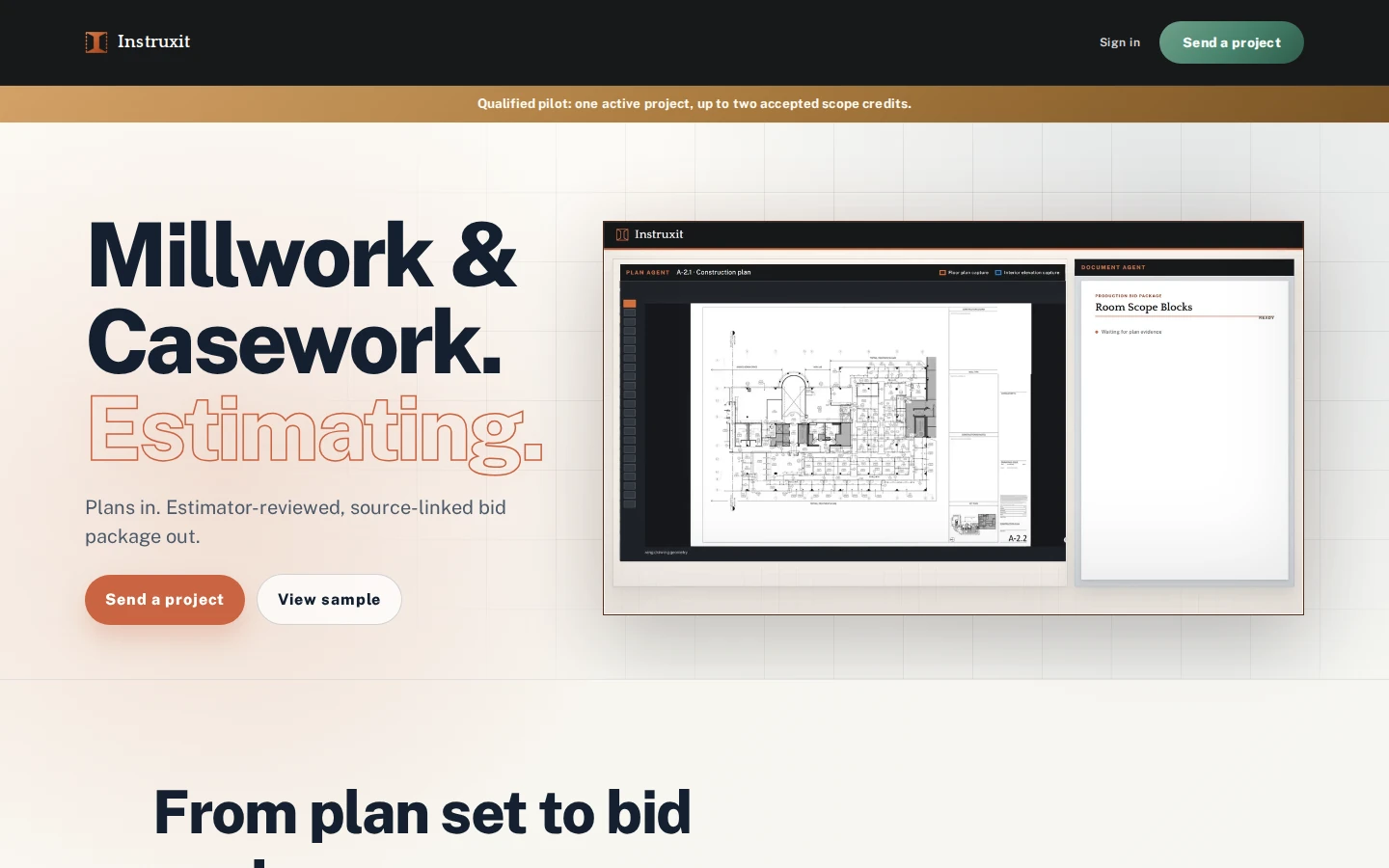
Instruxit
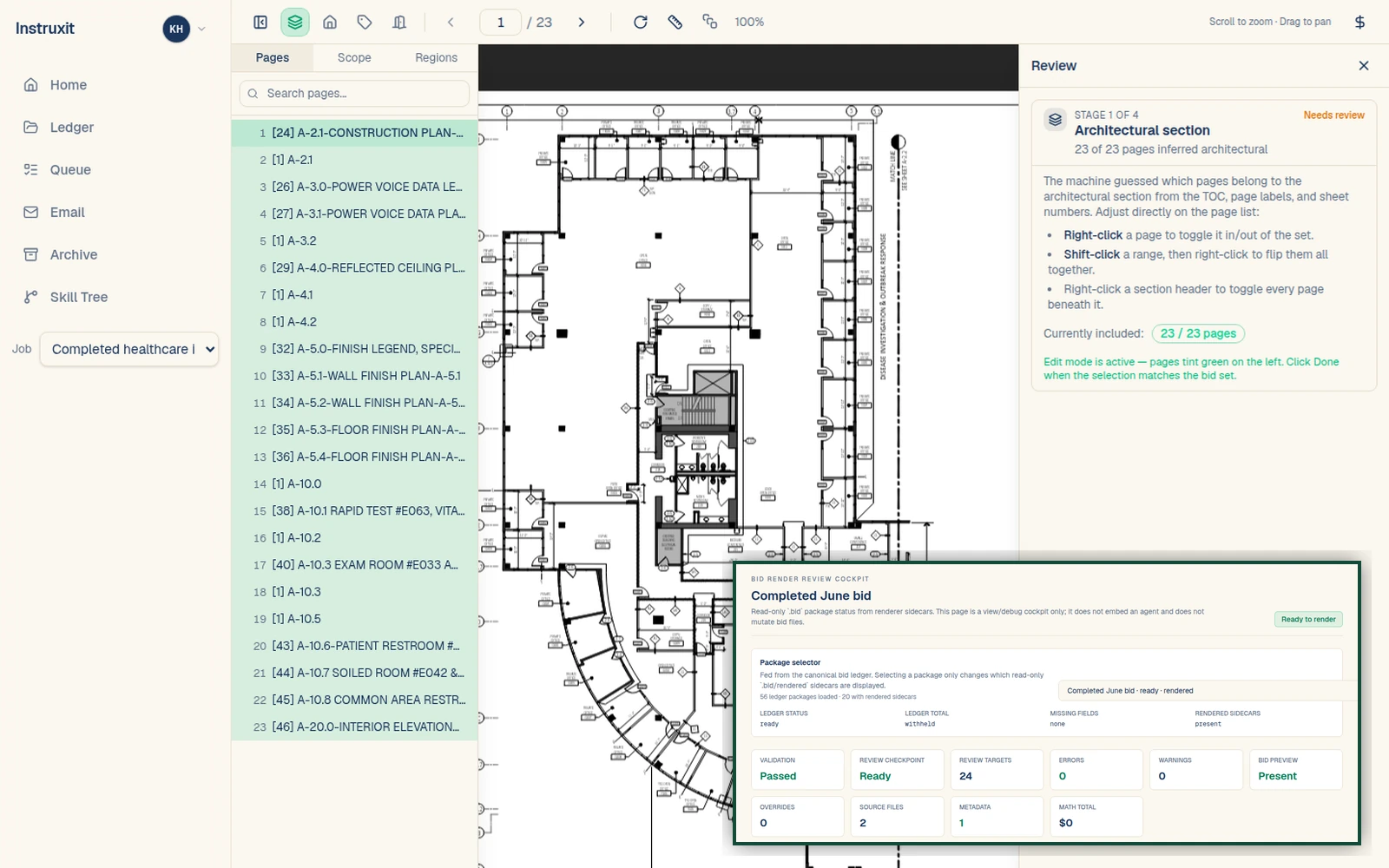
The deepest system I have built: a source-linked, human-reviewed path from hostile construction PDFs to organized bid work.
The observed result
~40 hoursto about 5
In one real bid cycle, the hands-on building portion fell from roughly forty hours to about five after the workflow matured.
Built with my brother, for the way he actually works.
This was not a solo miracle or a push-button estimator. Ken contributed roughly thirty-five hours of development and domain iteration alongside me. The plans arrived as PDFs—not clean CAD—and important decisions stayed reviewable by a human.
The value was in converting a frustrating pile of drawings, evidence, and scope decisions into one navigable work surface with traceable outputs.


02 · Systems that touch real operations
Web, mobile, hospitality, and the physical world.
These projects required more than producing a polished screen. I had to understand the source material, the operator, the deployment surface, and what I could truthfully claim.
02A
Everything Stevens
A modern web and mobile suite assembled from the restaurant’s public information, events, menus, and visual identity.
I built a React/Vite web experience, an Expo/React Native mobile prototype, reproducible content import, and browser QA across twenty-four routes at desktop and phone sizes. Android verification covered API 28 through 36.
Boundary: independent owner-preview work. I do not claim the restaurant adopted or commissioned the new product.
Open the interactive suite ↗


02B
Horizon Haven / AltonBnb
Before I ran its software, I helped rebuild the house.
The property had sat vacant for roughly twenty years. Working beside my dad, I helped with flooring, paint, roof and leak repair, insulation, kitchen and bathroom work, appliances, furnishing, yard work, plumbing, and electrical problem-solving.
Then I built and now operate much of the digital layer: direct booking, OwnerRez, Airbnb and Vrbo calendars, channel-aware pricing, guest presentation, and ongoing web operations. The property earned Airbnb Superhost status.
Visit the live property site ↗

03 · Value-first business concepts
I built the proof before asking for the opportunity.
These projects demonstrate research, responsive implementation, creative direction, and commercial thinking. The labels matter: an owner preview is not a customer win, and a proposal is not an adopted system.

Arce Custom Cabinets
I found a real San Diego millwork business, studied its public website and social footprint, organized its existing assets, and rebuilt the story across desktop and mobile to demonstrate the value before asking for a meeting.
This was lead generation through useful work—not a claim that Arce commissioned or adopted the site.

Human Way Center
A bilingual proposal built from the organization’s existing products and brand assets after an introduction through my uncle. I designed the content package, multimedia proof, ecommerce concept, and supervised-access boundaries.
Status: relationship handled by my uncle; awaiting feedback. No adoption claimed.

Surf City Epoxy
A researched garage-service concept that joined a customer-facing website, offer architecture, and premium visual direction around a clean Porsche workshop aesthetic.
Boundary: the garage visuals are generated concept media. No installation, adoption, or revenue result is claimed.
Open concept site ↗
04 · Experiments and unfinished edges
I build to understand what the technology can—and cannot—do.
These are not client outcomes. They are working experiments, reconstruction tests, spatial interfaces, and public demos that made the next technical question visible.

Single-image interior Gaussian
A live 3D reconstruction from one interior photograph. Source pixels are preserved; depth is model-estimated, and geometry hidden in the original image cannot be honestly recovered.
Open the live reconstruction ↗
Uptown Temecula study model
A walkable and drivable WebGL model using county parcels, OpenStreetMap, and SP-14 study material. The interface labels existing surveyed elements separately from proposed massing that does not exist.
Boundary: concept study—not a survey, entitlement claim, or representation of built architecture.
Open the public model ↗
Horizon exterior splat
A rougher all-image reconstruction kept in the archive because failed geometry is still useful evidence.

George’s Mexican Food
A real-business outreach concept built from public material and clearly presented as a demo.
Open ↗
Chuyitas Jericallas
A bilingual product story translating a local food identity into a clear digital storefront.
Open ↗05 · BetterBis
A place to turn technical range into practical business offers.
BetterBis is where I package the lessons: websites, email, phone, CRM, launch rooms, owner previews, and content systems for contractors and local businesses. It is also where I learn the commercial side honestly—scope, adoption, follow-up, and where good technical work still needs distribution.
Visit BetterBis ↗
How I work
One context. Several execution lanes. Evidence comes back to the center.
I use AI agents as tools inside a disciplined system—not as a substitute for judgment. Independent work can run in parallel; consequential claims still come back to one human-reviewed convergence point.
- 01Get close to the operation
Understand the room, property, estimator, screen, customer, or physical constraint before choosing the tool.
- 02Model the moving parts
Map people, data, software, approval boundaries, edge cases, and the cost of being wrong.
- 03Build the smallest complete loop
Connect a real input to a useful result instead of stopping at an attractive mockup.
- 04Verify what actually happened
Use tests, rendered screenshots, public links, and explicit claim boundaries. Prose is not proof.
The next useful system
Give me a real problem, a rough workflow, and room to learn.
I am looking for remote work—or the right Southern California team—where software has to connect to people, operations, media, or physical systems.
*About the 40→5 figure: this is a user-observed comparison from one real Instruxit bid workflow, not a controlled benchmark or universal guarantee. The build was collaborative, required substantial development and domain iteration from Ken, and retained human review.